Custom Ceramic Fiber Board: Sizes, Thickness & Shaped Parts
- Share
- Issue Time
- Oct 8,2026
Summary
Ceramic fiber boards can be cut, grooved, drilled, and machined to fit specific furnace chambers. Learn about custom sizes, thickness, and shaped parts.
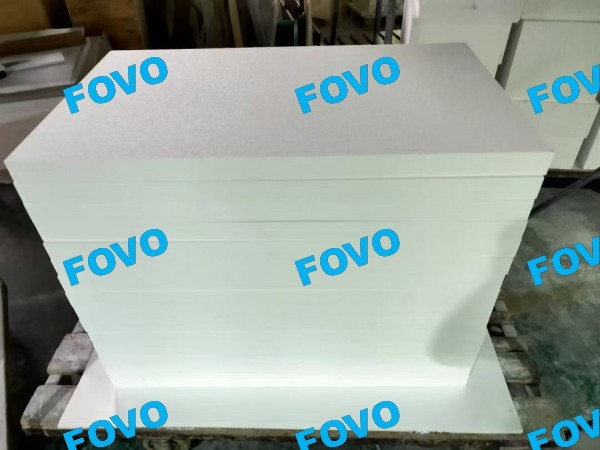
Custom Ceramic Fiber Board: Sizes, Thickness & Shaped Parts
Standard ceramic fiber board sizes are a starting point, not a limitation. For furnace builders and maintenance teams, the board that fits the chamber is the board that performs. A board that is too large requires cutting on site, which creates dust and wastes material. A board that is too thin or too thick compromises the thermal design. And a board that cannot accommodate a burner opening or thermocouple passage creates installation problems that delay the project.
This article explains the custom options available for ceramic fiber boards: custom sizes, custom thicknesses, and shaped parts machined to drawing.
Custom Sizes for Furnace Chambers
Ceramic fiber boards are produced in standard dimensions, typically 1000mm × 600mm or 900mm × 600mm. For small furnaces and laboratory chambers, these standard sizes may be sufficient. But for larger industrial furnace chambers, or for chambers with non-standard dimensions, custom sizes eliminate the need for on-site cutting.
Custom sizes are produced by cutting the board to the required length and width during manufacturing. The cut edges can be left as-cut or finished to a specific tolerance, depending on the application. For high-temperature furnaces where joint tightness is critical, finished edges with controlled tolerances provide a better fit than field-cut edges.
When ordering custom sizes, the key information to provide is: the required length, width, and quantity; the material grade and thickness; and any edge finishing requirements. For chambers with complex geometry, a drawing or template is helpful.
Custom Thickness for Thermal Design
Ceramic fiber boards are available in a range of standard thicknesses, typically from 6mm to 100mm. For many applications, a standard thickness works. But when the thermal design requires a specific thickness — for example, a 40mm hot face layer with a 60mm back-up layer — custom thickness ensures the wall construction matches the design.
Custom thickness is also useful for replacement work. If the existing lining has a non-standard thickness due to previous repairs or design changes, a custom-thickness board can match the existing wall without the need for additional layers or fillers.
The thickness tolerance for ceramic fiber boards is typically ±1mm for machined surfaces. For critical applications, tighter tolerances can be specified.
Shaped Parts Machined to Drawing
Not every lining component is a flat board. Burner openings, inspection ports, thermocouple passages, and door seals often require shaped parts that cannot be produced from a flat board alone. Vacuum forming and CNC machining allow these shaped parts to be produced as one piece, with the dimensions and tolerances specified in the drawing.
Shaped parts can include: boards with cut-outs for burner openings or inspection ports; grooved boards for thermocouple or heating element passages; bevelled edges for tight-fitting joints; and complex profiles for door seals or roof arches.
The production process for shaped parts begins with a drawing. The drawing specifies the overall dimensions, the location and size of any openings or cut-outs, the edge profile, and the tolerance requirements. The supplier then produces a mold for vacuum forming (if needed) and machines the final dimensions with CNC equipment.
For furnace builders, the advantage of shaped parts is that they arrive ready to install. No on-site cutting, no dust, no trimming. The part fits the opening as designed, and the installation process follows the planned sequence.
Material Grades for Custom Parts
Custom parts can be produced in any of the standard ceramic fiber board grades: 1260°C standard board, 1400°C high-alumina board, 1600°C polycrystalline mullite board, and 1800–1900°C alumina fiber board. The grade selection depends on the operating temperature of the specific furnace zone where the part will be installed.
For high-temperature zones above 1600°C, alumina fiber board is the appropriate material for custom parts. For zones below 1500°C, polycrystalline mullite board or high-alumina board may be sufficient.
Ordering Custom Boards: Information to Provide
When requesting a quote for custom ceramic fiber boards, the following information helps the supplier provide an accurate quote and production timeline: material grade and temperature rating; required dimensions (length, width, thickness); quantity; edge finishing requirements; drawing or sketch for shaped parts; and tolerance requirements.
For shaped parts, a detailed drawing is essential. The drawing should include all dimensions, the location of openings and cut-outs, and any tolerance callouts. If a drawing is not available, a template or a detailed sketch with dimensions can be used as a starting point.
Conclusion
Custom ceramic fiber boards are not a special order — they are a standard part of the product range for furnace builders and maintenance teams. Custom sizes eliminate on-site cutting, custom thickness matches the thermal design, and shaped parts accommodate burner openings, inspection ports, and other chamber features. When the board fits the chamber as designed, the lining performs as designed.